Medicare just recently published additional public data about what physicians received in fee-for-service payments from Medicare in 2014. Being an Emergency Medicine physician, I was naturally curious about this data and what information I could glean about our specialty.
The first thing I did was to download the data from Medicare, and I extracted only those providers who are in Emergency Medicine. For EM providers, Medicare publishes for how many cases of levels 3, 4, 5 and critical care ("CC") each provider was reimbursed. These are represented by 99283, 99284, 99285, and 99291.
Critical care, 99291, is a very interesting one because it is up to the doctor's judgement (more so than the other codes which have very strict criteria) as to whether a case qualifies for critical care. There are, of course, guidelines, but still, it's mostly a judgement call and the physician is expected to write a brief explanation as to why the case qualifies. Critical care, of course, is reimbursed at a higher level than level 3 through 5 cases.
The Medicare data set does not directly provide a critical care rate (the percentage of a provider's cases that are billed as critical care), but it can be derived from the dataset. This is the number to look at, because if you are billing a significant higher rate of critical care than your peers, it can raise red flags about your billing practice.
To derive the rate of critical care billing, I simply divided the # of CC for each provider by the sum of the number of level 3, 4, 5, and CC cases. Levels 1 and 2 were ignored in this calculation because they seem to be missing or very sporadic in the dataset. Additionally, the vast majority of cases in EM are 3 and higher. So admittedly, there is a small bias in this calculation (because level 1s and 2s are not included), but the bias is uniform.
I dumped the data into Tableau and then organized the data by state, so that providers can see who is charging critical care the most frequently in their respective states.
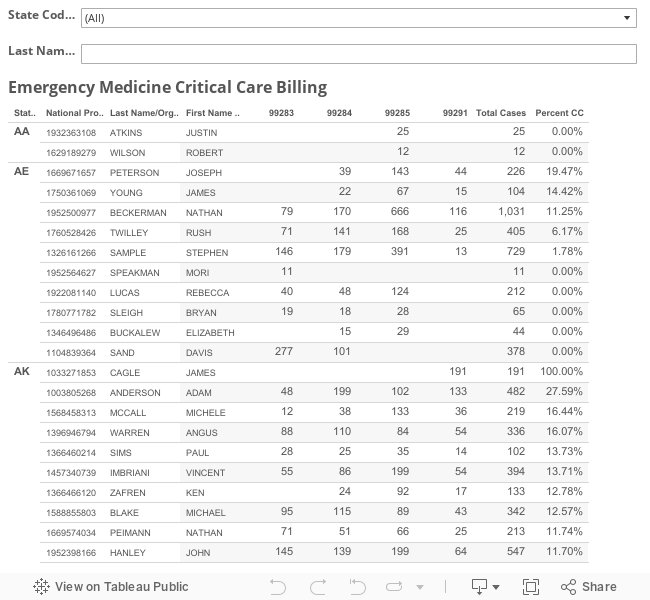
Mind you, there are lots of caveats to this data. Some ER doctors, obviously, work with sicker patients. Others might be critical care fellows and do *only* critical care. And I'm sure there are other situations I don't know about. Nonetheless, this is the data that Medicare has published, so we need to be aware of it.
I then aggregated the data by state and calculated state-wide averages for critical care and displayed them using Tableau's map function:

There's a lot more that can be extracted, but this is enough for today. If you like this sort of stuff, let me know and please visit my cool emergency medicine job search tool: jobmap.io! @amohseni or alexmohseni (at) gmail (dot) com.
The first thing I did was to download the data from Medicare, and I extracted only those providers who are in Emergency Medicine. For EM providers, Medicare publishes for how many cases of levels 3, 4, 5 and critical care ("CC") each provider was reimbursed. These are represented by 99283, 99284, 99285, and 99291.
Critical care, 99291, is a very interesting one because it is up to the doctor's judgement (more so than the other codes which have very strict criteria) as to whether a case qualifies for critical care. There are, of course, guidelines, but still, it's mostly a judgement call and the physician is expected to write a brief explanation as to why the case qualifies. Critical care, of course, is reimbursed at a higher level than level 3 through 5 cases.
The Medicare data set does not directly provide a critical care rate (the percentage of a provider's cases that are billed as critical care), but it can be derived from the dataset. This is the number to look at, because if you are billing a significant higher rate of critical care than your peers, it can raise red flags about your billing practice.
To derive the rate of critical care billing, I simply divided the # of CC for each provider by the sum of the number of level 3, 4, 5, and CC cases. Levels 1 and 2 were ignored in this calculation because they seem to be missing or very sporadic in the dataset. Additionally, the vast majority of cases in EM are 3 and higher. So admittedly, there is a small bias in this calculation (because level 1s and 2s are not included), but the bias is uniform.
I dumped the data into Tableau and then organized the data by state, so that providers can see who is charging critical care the most frequently in their respective states.
Mind you, there are lots of caveats to this data. Some ER doctors, obviously, work with sicker patients. Others might be critical care fellows and do *only* critical care. And I'm sure there are other situations I don't know about. Nonetheless, this is the data that Medicare has published, so we need to be aware of it.
I then aggregated the data by state and calculated state-wide averages for critical care and displayed them using Tableau's map function:

There's a lot more that can be extracted, but this is enough for today. If you like this sort of stuff, let me know and please visit my cool emergency medicine job search tool: jobmap.io! @amohseni or alexmohseni (at) gmail (dot) com.
Comments