
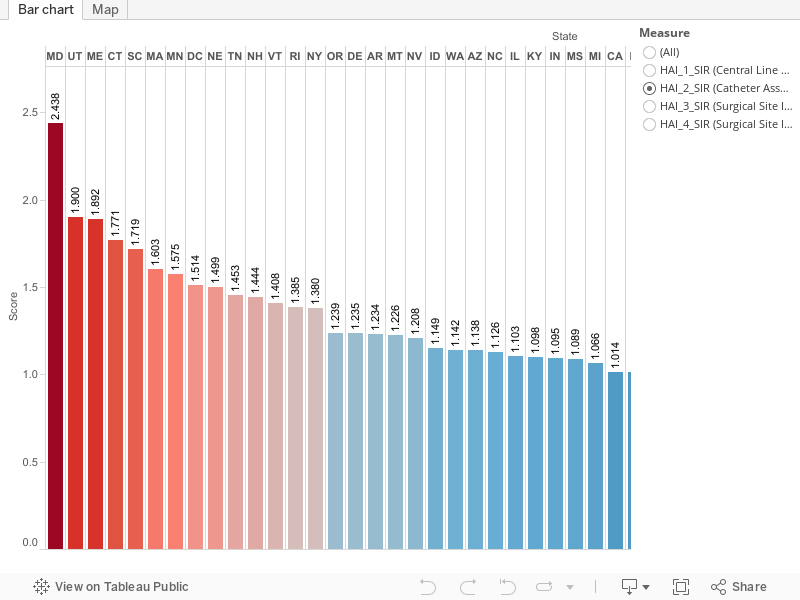
Alaska has highest rate of Central Line Associated Blood Stream Infections (CLABSI) in the country, and Maryland has highest rate of Catheter Associated Urinary Tract Infections.

According to the latest data I could find (last updated July 2013) Alaska has the highest rate of Central Line Associated Blood Stream Infections (CLABSI) in the country. CLABSI is only one of many hospital acquired infections. Here is the brief explanation of the data from CMS:
The Healthcare-Associated Infections (HAI) measures - state data. These measures are developed by Centers for Disease Control and Prevention (CDC) and collected through the National Healthcare Safety Network (NHSN). They provide information on infections that occur while the patient is in the hospital. These infections can be related to devices, such as central lines and urinary catheters, or spread from patient to patient after contact with an infected person or surface. Many healthcare associated infections can be prevented when the hospitals use CDC-recommended infection control steps.
There are four main Hospital Acquired Infections (HAI) being measured:
  1. HAI-1-SIR. Central Line Associated Blood Stream Infections (CLABSI)
  2. HAI-2-SIR. Catheter Associated Urinary Tract Infections (CAUTI)
  3. HAI-3-SIR. Surgical Site Infections from colon surgery (SSI: Colon)
  4. HAI-4-SIR. Surgical Site Infections from abdominal hysterectomy (SSI: Hysterectomy)
There is a very good explanation of the calculation methodology for Standardized Infection Ratios (SIR) on the Leapfrog website. Essentially, Alaska's score of 1.495 means that CLABSI is 49.5% more common in Alaska than expected number for the standard population.

Why are Hospital Acquired Infections important? There are many reasons, but the key reasons are that they cause harm to patients, they are preventable, and they cost a lot of money to treat.

I've created an interactive chart where you can look into the data more closely by either bar chart or map.

Comments

Popular posts from this blog

IEEPA Tariff Refund Checklist (2026): How U.S. Importers Can Recover Duties Without Missing Deadlines

 If your company paid IEEPA-related import duties in 2025–2026, the biggest risk right now is not “whether refunds exist.” The biggest risk is operational: teams miss filing windows, submit incomplete data, or assume refunds are automatic. They’re not. Recent legal and agency developments created meaningful refund opportunities for many importers. But recovery still depends on entry-level details, liquidation posture, and execution quality. This guide gives you a practical, deadline-first checklist to maximize recoverable dollars while minimizing avoidable errors. Important: This article is informational and not legal advice. Why this matters now Three facts can all be true at once: The Supreme Court changed the legal landscape for IEEPA tariffs. CBP is operationalizing refunds through staged systems and rules. Importers can still lose rights if they wait too long or file the wrong pathway. In plain English: the legal headline helped, but workflow discipline still de...

Dr. Alex Mohseni invited to speak at Brault’s Healthcare Leadership Forum about the future of Emergency Medicine services and how ED groups can adapt using telemedicine.

  Dr. Mohseni presented on the topic of how Emergency Medicine groups could expand their scope of practice to the virtual space to and how to do so in a financially viable way.

DisabilityProAI: Faster, Defensible Medical Record Summaries for Disability Cases

 If you’ve ever tried to prep a Social Security Disability (SSD/SSI) or long-term disability case with tens of thousands of pages of medical records, you know the grind: clunky PDFs, handwriting, labs and imaging in odd formats, and a mountain of data that must be accurate, complete, and cited to the page. That’s why we built DisabilityProAI . Below is a plain-English overview you can share with your team or clients: what it is, who it’s for, and how it solves the most painful parts of disability case prep—at scale. What is DisabilityProAI? DisabilityProAI is an AI-powered platform purpose-built for disability attorneys, hearing representatives, paralegals, and case managers . It ingests massive medical record sets (well over 500 MB) , performs high-quality OCR that preserves tables, forms, and handwriting structure , and produces accurate, page-specific, citation-rich summaries you can trust. It also lets you chat with the documents —ask follow-up questions, trace where f...